|
our impact :: conversations
It is Never Too Late
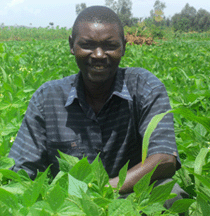
Conversation* with HENRY KAMAU, Vipani Farmer, December 22, 2007
Henry Kemau worked at the Prisons Department of the Kenya Ministry of Home Affairs for 15 years. While working there, he always said a prayer out of gratitude for his job. Although his job kept him away from his family, it allowed him to support his wife, Roslyn Wanjiru, and his five children decently. Henry knew that many of the people behind the prison walls were driven to a life of crime because they lacked the same opportunities.
In 1990, medical reasons forced Henry to retire early from his job at the Prisons Department. He then invested his savings in a vehicle repair shop in the Kangware slums in Nairobi. Henry struggled to keep his business afloat, but after 10 years of work the business collapsed. With his failing health, he returned home to Maragua and became a farmer, the only option that remained for him. He had to support his family somehow.
For over five years, Henry labored to grow French beans for several commercial companies. However, his earnings were meager and unreliable, and could hardly sustain his family. In 2006, at age 57 and his confidence lost, Henry despaired at his inability to get his family out of the trap they were in.
His life, after retirement, was not the one he had worked hard for. Like the people who had been held behind the prison walls, Henry lacked the opportunity to make things better. Hard work was just not enough.
Henry was almost resigned to his fate, when the local Vipani agent knocked on his door. Thinking he had nothing more to lose, Henry joined Vipani in July 2006.
Henry worked hard and today estimates that his net earnings since joining Vipani are over Ksh 100,000 (US$1600). He has put this money to good use. First priority was education - he was able to pay for his youngest child's high school fees with confidence. With money to spare at the end of 2006, Henry invested to expand his farm from 0.5 to 2 acres. He bought a Super MoneyMaker water pump (Ksh 8,000) and dug five new water wells (Ksh 12,500) to ensure that he would have a dependable source of water for irrigation. He also purchased a cow for milk (Ksh 8,000).
When asked to compare the past with his present situation, Henry begins with a smile and says, "Vipani has brought me back to life, I can afford to pay my family bills comfortably and plan for the future. My wife and I have bonded more; my family appreciates my work."
His wife could not agree more. "Before, Henry came home only a few times a year, and I took all the responsibility of bringing up our children. Now, we feel like a family and we feel secure, having a good source of income. With my husband's earnings from the farm, and my own from my small banana business, I am so happy that we have the means to enable our youngest child, Carol Njeri, to complete her studies. Life is so much better now."
Carol Njeri, a source of pride to her parents, feels confident about her education. "I am doing well in school. In fact, I am in a private secondary school; I transferred from public school because a good Samaritan noticed my good performance and offered me a partial scholarship. My father has managed to pay the rest of my school fees. I have no stress, and I can concentrate on my studies. I hope to go to college some day, maybe go abroad for further studies!"
She continues, "As you can see, you met me helping my father harvest French beans. After harvesting, I help him deliver them to the collection Center and I do the sorting with him. I am happy doing this over the holidays because I know that is how my father gets the money to pay my school fees. What makes me proud is that even though he is old, he earns a good income and spends it for us wisely. The grade cow at home was bought with income he earned since joining Vipani. My mother gets 10 liters of milk a day from it. We sell five liters and consume the rest with our extended family. I have learned a lot about agriculture. I think farming is a good way to earn a living."
Henry is excited about the future. "In the coming months, I plan to buy a motor pump to increase my production efficiency. In the long run, I plan to build a better house for my family. My family has been of great help, and we hope to make up for the lost years."
"Though I am old, I guess I am aging graciously. I am now a church elder and a village Mzee (respected elder). I give counsel to the families of my two late brothers and I support them where I can. I am happy to have joined Vipani; I have begun seeing the fruits. My wife is happy with me. I am pleased that one of my brother's sons has also joined Vipani; this will help him keep off drugs and alcohol and bring up his young family responsibly. My brother's widow, who also joined Vipani, is happy to have earned Ksh 5,000 from her first crop. I know it is the biggest amount she has ever earned."
As if to confirm his gratitude for the opportunity that he had with Vipani, Henry introduced five other neighbors to the program, in addition to his late brother's wife and son. Henry has become a beacon of hope for the people in his neighborhood, showing that, with Vipani, it's never too late to make it.
Samuel Mung'athia and Patrick Maina, Vipani staff, spoke to Henry on December 22, 2007
|
Vipani strives to
R E A C H
every farmer in a community who is stuck in the cycle of poverty.
Reach the poorest.
Enable every farmer.
Advance local support.
Catalyze local economies.
Help generate incomes.
Help Vipani REACH!

Vipani has the potential to help millions of poor farmers throughout the developing world escape poverty permanently. This potential can be realized only with your dedicated support.
|